

Transportation Intelligence: Why the Future Belongs to Organizations That Can Predict, Not Just Monitor

The gap between data abundance and predictive capability is costing organizations billions. Here's what's changing.
We live in an era of unprecedented transportation data. Every vehicle movement, traffic signal, delay, and deviation generates data points. Modern cities and logistics networks produce billions of these signals daily.
Yet most organizations remain fundamentally blind to what this data actually means.
They can tell you what happened yesterday. They struggle to explain why. They certainly can't tell you what will happen tomorrow—or what to do about it.
This is the intelligence gap. And it's costing governments and enterprises billions in preventable accidents, wasted resources, and missed opportunities.
The Problem: Data Rich, Intelligence Poor
Consider these scenarios:
Government transportation agency:
Monitors 1,000+ intersections generating millions of daily data points
Identifies accident-prone locations only AFTER multiple incidents occur
Struggles to prioritize limited infrastructure budget across countless needs
Cannot predict whether proposed interventions will actually work
Logistics company:
Operates 500 vehicles making 8,000 deliveries weekly
Plans routes using current traffic data (already outdated when vehicles depart)
Loses 15-20% of deliveries to unpredictable delays
Accepts congestion and disruption as "inevitable"
The common thread: Mountains of data, but no intelligence to convert it into competitive advantage.
What Transportation Intelligence Actually Is
Transportation Intelligence is NOT:
❌ Traffic monitoring systems (reactive dashboards)
❌ GPS navigation (individual route optimization)
❌ Smart city platforms (horizontal infrastructure)
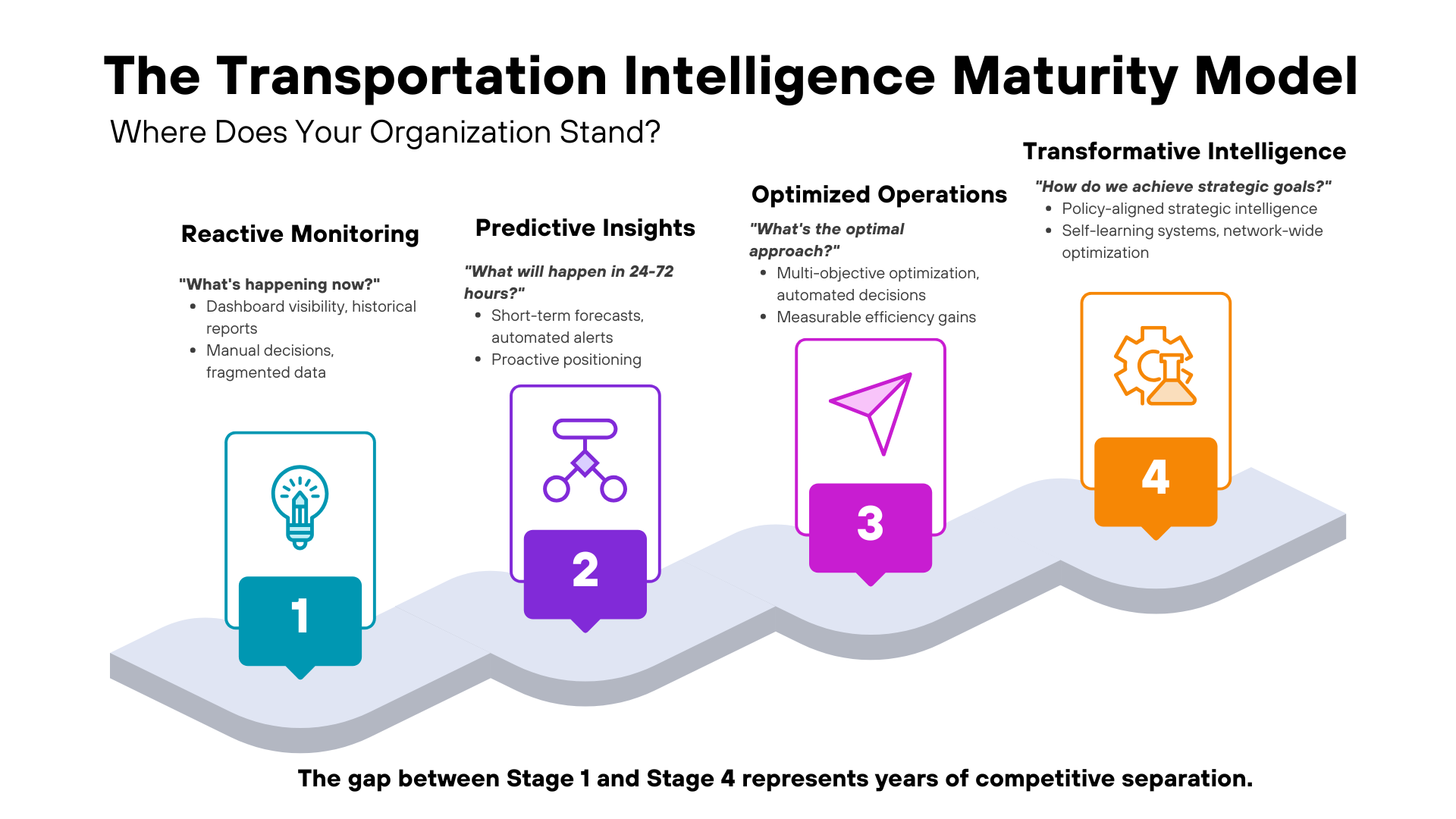
Transportation Intelligence IS:
The capability to understand, predict, and optimize mobility networks using AI-powered analysis.
Access the Full Whitepaper
This whitepaper provides a comprehensive overview of Transportation Intelligence, including predictive analytics, optimization frameworks, and real-world deployment examples.
Inside the whitepaper:
The Predictive Intelligence Methodology: From high-density data collection to actionable insights
Data integration and AI workflows: How multi-source traffic and sensor data are processed and analyzed
Operational and strategic applications: How predictive insights can improve safety, efficiency, and policy outcomes
Real-world case studies: National-scale deployment examples, including 546M+ traffic records and 1,000+ intersections analyzed
Impact assessment: Quantified benefits on safety, congestion, emissions, and operational efficiency
